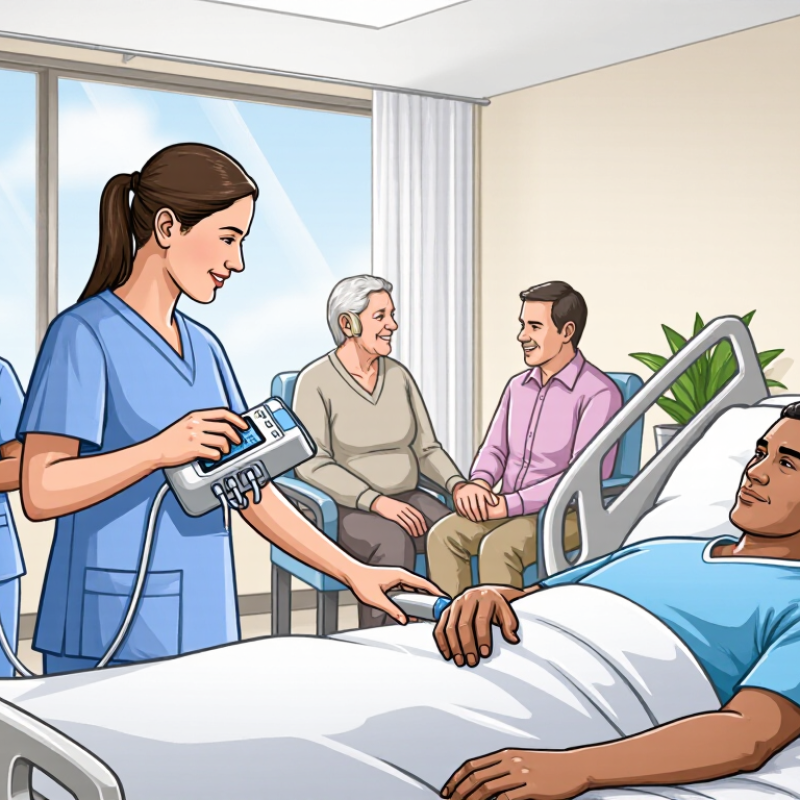
How Medical Devices Improve Patient Care is best understood through ordinary clinical moments, not futuristic promises. A nurse checks an oxygen monitor beside a patient’s bed. A portable ultrasound helps a clinician examine a painful area without moving the patient far. A well-fitted hearing aid can make a family conversation easier to follow. These tools support observation, diagnosis, treatment, and daily independence. They do not replace clinical judgment.
Surgeon and writer Atul Gawande wrote, “Better is possible.” That principle applies to thoughtful device design and careful use. A reliable monitor may help staff notice a change sooner, while an infusion pump can deliver a prescribed dose at a controlled rate. Yet the device is only one part of care. Staff need training, clear instructions, maintenance, and time to interpret results. A screen can display numbers. It cannot understand a patient’s fears or explain every clinical choice.
The benefits are not automatic. Alarms can create fatigue, complicated controls can lead to mistakes, and cost may limit access. Even effective technology can feel frustrating when it does not fit a patient’s routine. These details deserve honest attention. Patient care improves when devices are safe, suitable, and supported by skilled people. The best outcomes come from combining useful technology with listening, follow-up, and sound clinical decisions. That is a practical starting point for understanding how medical tools can help—without treating them as cures for every problem.
Pulse oximetry gives clinicians a quick, painless way to check oxygen levels in a newborn’s blood. A small sensor clips onto the baby’s hand or foot, using light to estimate oxygen saturation. In 2012, research reported about 76% sensitivity for detecting critical congenital heart defects. That means screening identified roughly three out of four affected newborns in the studied setting. A quiet reading can still matter.
But screening is not a diagnosis. Some heart defects may not lower oxygen levels enough to trigger an alert, so a normal result cannot rule them out. Staff may compare readings from the right hand and a foot, while also considering the baby’s symptoms and physical examination. The percentage is helpful, but imperfect; real-world performance can vary with timing, technique, and the population screened. A calm baby, a warm foot, and a well-positioned sensor can support a reliable reading.
Tips: Keep the sensor snug, not tight, and wait for a steady reading. If the result is abnormal, follow the care team’s assessment rather than interpreting the number alone. Ask how follow-up works. A normal screen is reassuring, not absolute.
A continuous glucose monitor (CGM) measures glucose through a small sensor worn on the body. Instead of offering only occasional finger-stick readings, it shows how levels change through the day and night. A person might notice a rise after breakfast or a low during an evening walk. Those patterns can support more informed conversations with a clinician.
In the 2017 DIAMOND study, adults with type 1 diabetes using insulin injections were assigned to CGM or usual care with finger-stick testing. After 24 weeks, the CGM group’s HbA1c fell about 0.6 percentage points more than the usual-care group’s. That is meaningful, not magic. The result describes an average difference in a specific study, not a promise for every patient.
The practical value may lie in seeing changes soon enough to discuss them and adjust care safely. Alerts can also draw attention to overnight lows that might otherwise go unnoticed. Still, wearing a sensor takes effort, and readings can be distracting or imperfect. A device cannot replace clinical judgment, affordable access, or the patient’s own experience. The numbers help—but they do not tell the whole story.
| Measure | Continuous glucose monitoring (CGM) group | Usual-care group | Study finding |
|---|---|---|---|
| Study design | Randomized clinical trial comparing CGM plus usual diabetes care with usual care alone. | Outcomes were assessed over 24 weeks. | |
| Participants | 105 adults with type 1 diabetes assigned to CGM. | 53 adults with type 1 diabetes assigned to usual care. | 158 participants were randomized. |
| Eligibility context | Adults using multiple daily insulin injections, with baseline HbA1c from 7.5% to 9.9%. | The findings apply to the population enrolled in the trial. | |
| Mean HbA1c change at 24 weeks | Decreased by 1.0 percentage point. | Decreased by 0.4 percentage point. | Greater reduction with CGM. |
| Adjusted between-group difference | CGM group had a 0.6-percentage-point greater HbA1c reduction. | 95% confidence interval: 0.3 to 0.8 percentage point greater reduction; P < 0.001. | |
| Interpretation | In this trial, adding CGM to usual care improved HbA1c over 24 weeks compared with usual care alone. | ||
In the TASMINH4 study, telemonitoring helped lower systolic blood pressure by 4.7 mmHg compared with usual care after 12 months. Patients measured their blood pressure at home and sent readings to their care team. That meant clinicians could review real numbers from everyday life, not just a single clinic visit. A cuff, a quiet chair, and a few minutes of stillness became part of ongoing care.
Small changes matter. Blood pressure can vary with stress, activity, and even measurement technique. Regular readings gave clinicians more information when considering treatment adjustments. The device did not make decisions on its own, and it did not replace professional judgement. Its value came from connecting home measurements with clinical follow-up.
Still, telemonitoring may not suit everyone: reliable readings take practice, and sharing data can feel burdensome. A missed measurement or an incorrectly placed cuff can also distort the picture. The result is encouraging, but it is not a promise that every patient will see the same improvement.
Medical devices improve care by helping clinicians detect changes, guide treatment, and support recovery. The World Health Organization’s Global Atlas of Medical Devices (2022) estimates that around two million types are classified into more than 7,000 generic groups. That is a vast clinical toolkit. It ranges from a simple thermometer to imaging systems, infusion pumps, and mobility aids. At a bedside, a blood-pressure cuff can reveal a worrying trend; in a rehabilitation clinic, a properly fitted walking aid can help someone move safely.
The number of categories shows clinical reach, but not real-world access. A device in a warehouse helps nobody. The WHO and UNICEF’s Global Report on Assistive Technology (2022) estimates that 2.5 billion people need one or more assistive products, while nearly one billion lack access. These products are a related field, not a direct count of all medical devices. Still, the gap is a useful warning: technology alone does not deliver better care. Devices need suitable maintenance, trained users, reliable supplies, and clear instructions. The details matter. Even a precise monitor can mislead if it is poorly calibrated or used without context. Classification also has limits; thousands of groups cannot capture every patient’s needs, or every clinic’s constraints. A careful selection process is less visible than the device itself, but it often shapes what patients experience.
The figures cited in the headline describe different levels of classification: individual device types and broader groups. The logarithmic scale makes both counts visible; they are not equivalent units.
A small sensor uses light to estimate oxygen levels in a baby’s blood. It clips onto a hand or foot.
A 2012 study reported about 76% sensitivity. Roughly three out of four affected newborns were identified in that setting.
No. Some defects may not lower oxygen enough to trigger an alert. A normal screen is reassuring, not absolute.
Keep the sensor snug, not tight, and wait for a stable reading. A warm foot may help.
Follow the care team’s assessment. Ask what follow-up is planned; the number alone cannot explain everything.
In one study, telemonitoring lowered systolic blood pressure by 4.7 mmHg versus usual care after 12 months. Clinicians reviewed readings taken at home.
Stress, activity, and measurement technique can change results. Sit quietly, place the cuff correctly, and take time.
No. It connects home readings with clinical follow-up, but clinicians still make treatment decisions. It may also feel burdensome.
How Medical Devices Improve Patient Care can be seen across screening, treatment, and ongoing monitoring. Pulse oximetry screening can help identify critical heart defects in newborns, with a reported sensitivity of 76% in a 2012 study. Detecting potential problems early can help clinicians decide whether further assessment is needed. For people with diabetes, continuous glucose monitoring was associated with a 0.6-point greater reduction in HbA1c than usual care in the 2017 DIAMOND study, supporting more informed day-to-day treatment decisions.
Medical devices can also help care teams track health outside routine appointments. In the TASMINH4 study, telemonitoring was linked to a 4.7 mmHg reduction in systolic blood pressure, showing how remote measurements may support blood-pressure management. These examples reflect the broad reach of medical technology: the World Health Organization counts about two million types of medical devices across 7,000 groups. Together, such tools can support earlier detection, better-informed care, and continued monitoring.

MDV Medical