In 2026, How Medical Devices Improve Clinical Workflow is not only a question of faster equipment. It is about helping care teams make timely decisions with less avoidable friction. A connected monitor can send vital signs directly to a clinical record, while a portable ultrasound can bring imaging to a patient’s bedside. When devices share information reliably, clinicians may spend less time re-entering values and more time assessing patients. That difference matters during a crowded shift. Small steps count.
Surgeon and writer Atul Gawande offers a useful standard for evaluating improvement: “Better is possible. It does not take genius. It takes diligence. It takes moral clarity. It takes ingenuity. And above all, it takes a willingness to try.” His words are not specifically about medical devices, but they fit the work of introducing them responsibly. Teams need training, clear procedures, and time to test whether a device genuinely supports care. A dashboard that adds alerts without improving decisions can create noise instead of relief. That part is easy to overlook.
This introduction examines how connected devices, point-of-care tools, and automation can support documentation, communication, and patient monitoring in 2026. It also considers practical limits, including compatibility, usability, and staff workload. Better workflow is not guaranteed by new technology alone. Real clinics are messy, and implementation can be uneven. The useful question is whether a device makes the next clinical step clearer, safer, and more manageable for both staff and patients.
The 2016 baseline cited here puts EHR work at 49.2% of physicians’ working time. That is a historical measure, not a prediction for every clinic today. Still, it shows how documentation can compete with patient care. Picture a clinician entering notes after an exam, then retyping a vital sign already recorded elsewhere. Small repetitions accumulate. Current workflows should be measured locally, because staffing, specialties, and software differ.
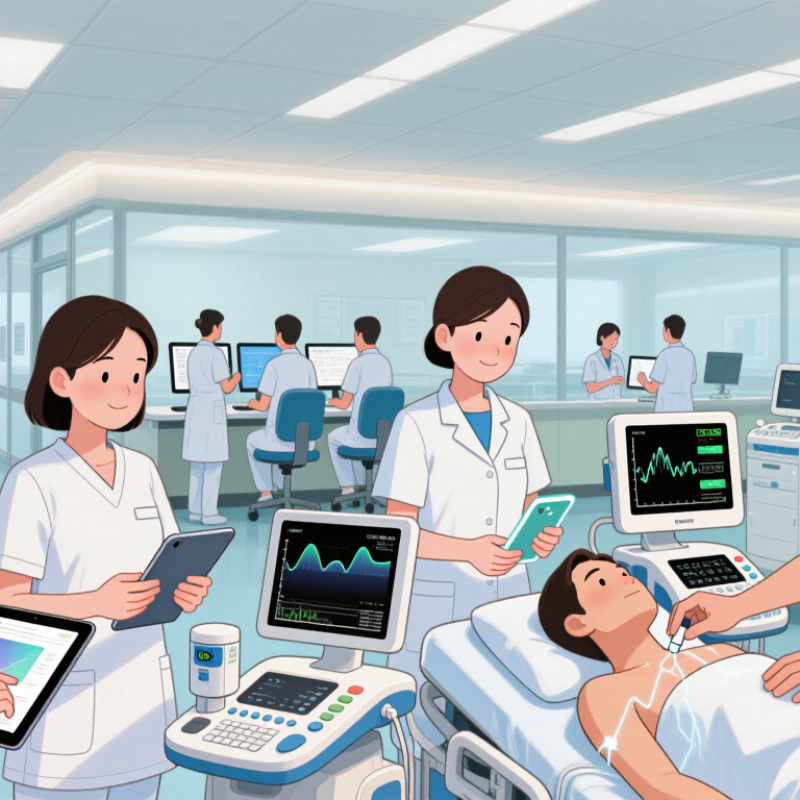
Well-integrated medical devices can send measurements directly into clinical records, reducing duplicate entry and transcription errors. A connected monitor, for example, may transfer a patient’s oxygen level and pulse without another manual step. Clear device displays can also help staff spot unusual readings sooner. But automation does not fix a confusing process by itself. Poorly timed alerts or missing data can create new work. That part deserves more attention than it often gets.
Tips: Track minutes spent documenting before and after a device change. Ask clinicians where data entry interrupts care. Check that transferred readings include units and timestamps. Keep a manual fallback for connection failures, and review alert settings with the people who use them. A few minutes saved on paper may not feel dramatic, but repeated across a full clinic day, the difference can matter.
| Workflow area | Baseline evidence | Potential device-enabled contribution | Practical measure for 2026 |
|---|---|---|---|
| EHR and documentation | The historical baseline in this title reports that EHR tasks accounted for 49.2% of physicians’ work time in 2016. This is a historical figure, not a 2026 estimate. | Integrated dictation, mobile access, and direct transfer of measured data may reduce repetitive entry when they fit the clinical workflow. | EHR minutes per visit; documentation completed during versus after clinic; duplicate-entry rate. |
| Vital-sign collection | Vital signs are routinely collected as part of clinical assessment; the 49.2% figure does not specify how much time is spent on this task. | Connected measurement devices can make readings available for review and may avoid manual transcription when interoperable with the EHR. | Time from measurement to chart availability; transcription errors; repeat measurements caused by missing or invalid data. |
| Medication reconciliation | Medication review is a clinical safety task. The historical time-share figure does not quantify medication-reconciliation time or errors. | Barcode-enabled medication workflows and connected records may support accurate identification and review; clinical confirmation remains necessary. | Reconciliation completion rate; discrepancies identified and resolved; time spent per reconciliation. |
| Point-of-care testing | Point-of-care tests can provide results during an encounter. The 2016 EHR baseline does not report test turnaround or workflow effects. | Connected analyzers may transmit results to the clinical record and support timely review, subject to validation and local integration. | Collection-to-result time; result-to-clinician-review time; manual result-entry rate. |
| Remote patient monitoring | Remote monitoring shifts some measurements outside the clinic, but its effect on clinician workload depends on alert volume, patient population, and staffing. | Home measurement devices and monitoring systems can support follow-up between visits when readings are reviewed through a defined care pathway. | Readings reviewed per staff hour; actionable-alert rate; time to follow-up; unreviewed alert count. |
| Device-to-EHR integration | The 49.2% historical figure describes EHR-related work broadly; it does not establish that devices alone can reduce that share. | Standards-based data exchange can reduce re-entry and make device results easier to find, provided data mapping, identity matching, and workflows are reliable. | Successful data-transfer rate; duplicate-entry rate; interface downtime; staff-reported usability. |
Interpretation: The 49.2% figure is presented as a historical baseline from 2016, as specified in the title. Device contributions are workflow opportunities, not guaranteed outcomes; evaluate them with local time, quality, and safety measures.
A physician survey found that 66% used AI in practice, up from 38% in 2023. Adoption alone does not show that every tool helps.
It can draft visit notes from speech, including symptoms, decisions, and follow-up instructions. Less typing, perhaps. Clinicians still need to review the draft.
Check medication names, dates, negations, and the patient’s wording. A missed “not” can change a care plan.
The list included 1,016 AI/ML-enabled devices. This is a snapshot, not proof of benefit.
A tool may flag a possible finding on a scan for clinician review. The clinician should also consider the image, patient history, and reason for the exam.
Check whether it fits existing records and screens, and whether staff can correct errors quickly. Tell patients when their conversation is being processed. Trust depends on these details.
Compare setup, documentation, and treatment times before and after rollout. Track alarms, near misses, and completed handoffs too. A dashboard can miss bedside workarounds.
Overall averages can hide delays or problems in specific settings. Ask staff what became harder, even when the numbers look tidy. That part is easy to overlook.
How Medical Devices Improve Clinical Workflow in 2026 begins with understanding where clinicians’ time goes. In 2016, electronic health record tasks accounted for 49.2% of physicians’ work time, highlighting the need to make documentation and information access more efficient. As certified EHR adoption reached 96% of U.S. hospitals, connected devices and digital systems created more opportunities to share relevant information with care teams and support coordinated treatment.
Automation and decision support may further reduce routine workload, while keeping clinicians responsible for patient care. Physician use of AI rose to 66% in 2024, and the FDA listed 1,016 AI- and machine-learning-enabled medical devices that year. To determine whether these tools genuinely improve workflow, healthcare organizations should track practical outcomes such as time spent on administrative tasks, safety indicators, and the quality of care coordination. Measuring these changes helps teams identify what works and where workflows still need improvement.

 MDV Medical